What a difference a day makes… Final payments on the corporate tax are due on March 15, so each year there is a flurry of payment and processing activity at the Franchise Tax Board immediately after the Ides of March. This year, over 50 percent of all the March collections for this tax were reported on just two days—March 16 and 17. This pattern is persistent, with small variations. For example in 2013, a similar percentage of all collections were reported on March 17 and 18. We will see a similar flurry of activity for individuals around the middle of this month as April 15 appears.
Tuesday, April 1, 2014
Tax Season Begins
Although
some taxpayers can procrastinate, April has started with a sizable inflow. Personal income taxes net of refunds totaled
$458 million on April 1. This number
included money received during the weekend and Monday’s Cesar Chavez
holiday. Adding in a small amount of
corporate taxes and retail tax receipts, the total of California’s three major
resources clocked in at $513 million. One-half
billion dollars is a good start to reaching the state’s forecast goal of about
$13 billion for April as a whole.
What a difference a day makes… Final payments on the corporate tax are due on March 15, so each year there is a flurry of payment and processing activity at the Franchise Tax Board immediately after the Ides of March. This year, over 50 percent of all the March collections for this tax were reported on just two days—March 16 and 17. This pattern is persistent, with small variations. For example in 2013, a similar percentage of all collections were reported on March 17 and 18. We will see a similar flurry of activity for individuals around the middle of this month as April 15 appears.
What a difference a day makes… Final payments on the corporate tax are due on March 15, so each year there is a flurry of payment and processing activity at the Franchise Tax Board immediately after the Ides of March. This year, over 50 percent of all the March collections for this tax were reported on just two days—March 16 and 17. This pattern is persistent, with small variations. For example in 2013, a similar percentage of all collections were reported on March 17 and 18. We will see a similar flurry of activity for individuals around the middle of this month as April 15 appears.

April 1
California
consumers provided the state’s tax coffers with a slow inflow of receipts for
the first day of April. Preliminary
numbers show that sales tax receipts, which reflected sales for both the
weekend and Monday (government offices were closed for the Cesar Chavez
Holiday), totaled $10.3 million. This
was less than half, or $12.7 below estimates for the day.
The state’s
revenue estimators monitor historical and current revenue trends throughout the
year and update their revenue estimates formally three times a year. To make each update they rely on recent tax
and economic activity to fine-tune their estimates for the current- and
budget-year. The May Revision changes,
due on or before May 14 of each year, tend to be the most significant.
March Goes Out Like a Lion
California’s
tax receipts ended March more like a lion than a lamb, surpassing the $6
billion mark and beating both last year’s numbers and the projected total for
this year by wide margins.
Totaling $6.1 billion, tax revenues from the state’s main three sources (personal income, corporate income, and sales tax) were nearly $400 million above estimates made for March earlier this year as part of the Governor’s Budget. The number was close to $600 million higher than the total generated by the economy a year ago. This year’s performance reflects the recovery in California’s economy and the strong gains in stock prices and home values. Notably, all three major California sources joined in outperforming this year’s estimates and the year-ago figures.
April 2014 tax reporting not only helps budget writers monitor actual receipts for the 2013 tax year, it informs their thinking about the likely taxpayer behavior in 2014 and helps model likely tax receipts in April 2015. For example, it tells them something about the likely tax base: More than 60 percent of all income tax collections are derived from wages and salaries. If the 2013 tax returns show an increase in the wage and salary base, it is likely that the increase will continue in 2014.
Totaling $6.1 billion, tax revenues from the state’s main three sources (personal income, corporate income, and sales tax) were nearly $400 million above estimates made for March earlier this year as part of the Governor’s Budget. The number was close to $600 million higher than the total generated by the economy a year ago. This year’s performance reflects the recovery in California’s economy and the strong gains in stock prices and home values. Notably, all three major California sources joined in outperforming this year’s estimates and the year-ago figures.
April 2014 tax reporting not only helps budget writers monitor actual receipts for the 2013 tax year, it informs their thinking about the likely taxpayer behavior in 2014 and helps model likely tax receipts in April 2015. For example, it tells them something about the likely tax base: More than 60 percent of all income tax collections are derived from wages and salaries. If the 2013 tax returns show an increase in the wage and salary base, it is likely that the increase will continue in 2014.
Friday, March 28, 2014
Tax Receipts on a Winning Streak
March
madness is ending with revenues flowing into state coffers at a good pace. Based on preliminary estimates through March
28, tax receipts from California’s three major revenue sources have totaled $5.8
billion, exceeding estimates for the total month by over $100 million. This will represent the close for the month
because of the upcoming weekend and the Cesar Chavez State Holiday on
Monday. The March number could be
revised significantly when released on Tuesday after any corrections are made
and auditing is completed. Looking at
the fiscal year-to-date, numbers through March show that total revenues are
ahead of Budget projections by about $1.3 billion or 2.2%. This is a nice margin to have if it lasts.
Budget
projections are difficult to make. Keep
in mind that current projections contained in the Governor’s new budget
presented early this year were based on actual data that was already available
for about half the fiscal year. When
the focus shifts to Fiscal Year 2014-15, with the release of the May Revision
of the Budget, revenue numbers will solely reflect projections.
How precise
are General Fund revenue estimates?
Given the range of variables that affect revenues—including the economy,
the weather, and changes in federal law or taxpayer behavior—the estimating error can easily rise. One
study found that if the estimators could control for variations in the economy,
the estimating error would hover around 5.0 percent. The consequences for this built-in error
rate can have a big effect on budget planning, deficits, and the health of the
General Fund.
By way of
comparison, the 2013 American League batting champion, Miguel Cabrera, got on
base 1.7 percent more often than did the National League’s champion, Michael
Cuddyer. If budget projections could be
limited to just that much difference between estimates and actuals, even then
the revenue swing would be nearly $2 billion.
A $2 billion “windfall” is a happy, healthy gain. A $2 billion “shortfall” can have immediate
and long-term consequences to many programs supported by the General Fund.
Retail Sales Perk Up
After
lagging behind projections during most of March, retail sales may be picking up
as the month comes to an end. During the
last two days (March 27 and 28), month-to-date totals have exceeded forecasts. With weekend sales still to be tallied, tax
receipts are at 99.8% of the target for the month as a whole.
Sales tax
receipts during the past week are also running well ahead of a year ago. This is impressive since Easter fell at the
end of March last year (March 31) but will not occur this year until the latter
part of this April (April 20).
The Tax
Tracker reports revenue collected from the corporate, sales and personal income
taxes, irrespective of into which account the revenue is deposited. For example, the proceeds of a surcharge on
high-income taxpayers is earmarked for mental health services. Because a piece of the income and sales
taxes are earmarked for specific programs, the general progress of annual
collections are as important to those who monitor these programs as well as it
is to those watching the health of the General Fund.
March Revenues Reach Target Before Month-End
Supported by
continued gains in jobs, income, and capital gains, revenues through March 27
from California’s top three tax sources have already surpassed the projections
for the total month. With a few days
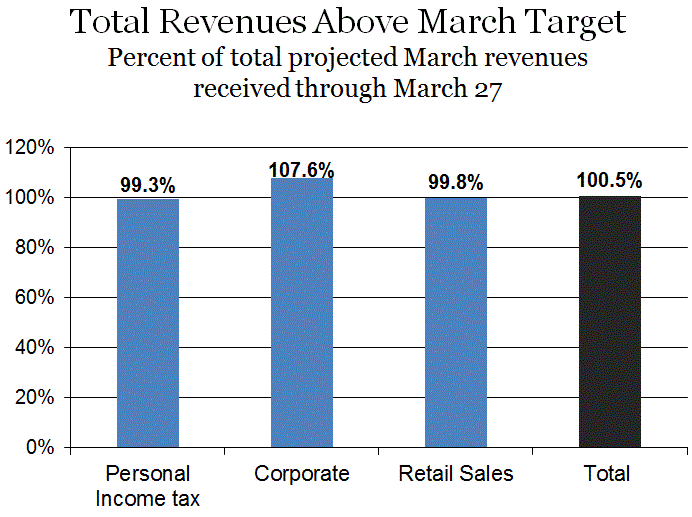
left to go, the total is at 100.5% of the target for all of March.
Personal
income tax collections have not quite reached their month-end target, but as
more individuals file their returns, the goal should be reached. Retail sales taxes are also close to their
target. Meanwhile, corporate tax
receipts are running well ahead of plan, with the sum through March 27 already
equal to 107.6% of the total month’s projection.
The third
quarter of 2013-14 closes with March. It
can include a great deal of information about how revenues are performing for
the year. It includes the results of the
late holiday retail sales and the final payments on most Corporate tax
accounts. Budget writers can use this
information to begin assessing the likelihood of meeting the budget estimates
for two of the three main General Fund revenue sources. Through March 27, total net revenues are
running $1.5 billion above the projections for the fiscal year to date.
Thursday, March 27, 2014
March
appears to be headed for a strong finish in personal income and corporate tax
payments. For the month through March
27, personal income taxes (net of refunds) totaled $2.7 billion, a gain of $292
million from a year ago and $161 million above estimates. Capital gains have been substantial, with
stock prices up 18% over the past year accompanied by a 21% climb in home
prices.
For much of
the month of March, corporate income taxes have been outperforming
estimates. For the month through March
27, corporate taxes totaled $1.5 billion, a number $108 million above
estimates. This outperformance reflects
the improvement in the operating profits of many companies and the ending of
write-offs from prior years’ losses.
Yesterday
was the 19th working day of the month. Compared to last year, cumulative
monthly collections for the three major taxes have been consistently higher
since mid-March. If collections continue at this pace, the state can
expect to collect over $6 billion in March, generating roughly $700 million
more than last year, and posting a 13% year-over-year change
Subscribe to:
Posts
(
Atom
)